
By Don Sadler
Many perioperative teams today include employees from four or maybe even five different generations: Traditionalists, who were born between 1925 and 1945; Baby Boomers, who were born between 1946 and 1964; Generation X, who were born between 1965 and 1980; Millennials, who were born between 1981 and 2000; and Generation Z, who were born between 2001 and 2020.
Employees from these generations bring different expectations and life experiences to any work environment including the OR. While these different perspectives can be beneficial, they can also be challenging for perioperative leaders tasked with leading multigenerational teams.

“In today’s diverse workforce, understanding and respecting generational differences is essential for effective leadership, especially when it comes to surgical patient care,” says Christina McDonald, MHA senior director of ASC operations at Trias MD. “It’s crucial for perioperative leaders to recognize the unique perspectives, values and communication styles each generation brings to the team.”
Understand Generational Viewpoints
Justin Fontenot, DNP, RN, NEA-BC, FAADN, Editor-in-Chief of Teaching and Learning in Nursing, believes that society evolves largely by the influence of up-and-coming generations.
“It’s critical that leaders in health care understand the work-related viewpoints of various generational groups,” says Fontenot. “This can provide leaders with perspective to improve the workplace setting for all team members, regardless of the generation they were born into.”
“Perioperative leaders must understand the worldview and communication styles of each generation and motivate them to work together as a high performing team,” says Deborah Marie Ebert, MSN, RN, NEA-BC, CNOR, CCRN-K, CPAN, CAPA, associate vice president, perioperative services at Memorial Hermann Texas Medical Center in Houston, Texas.
But this has become more challenging than ever, notes Ebert.
“As leaders, we must support each team member in connecting to their purpose, as well as their value to the perioperative team,” she says.
Vangie Dennis, MSN, RN, CNOR, CMLSO, believes that intergenerational conflicts in the workplace often result from not understanding different value systems, communication styles and expectations, such as work-life balance.
“This can stem from misconceptions about each individual’s unique experiences and the different perspectives held by members of different generations,” she says.
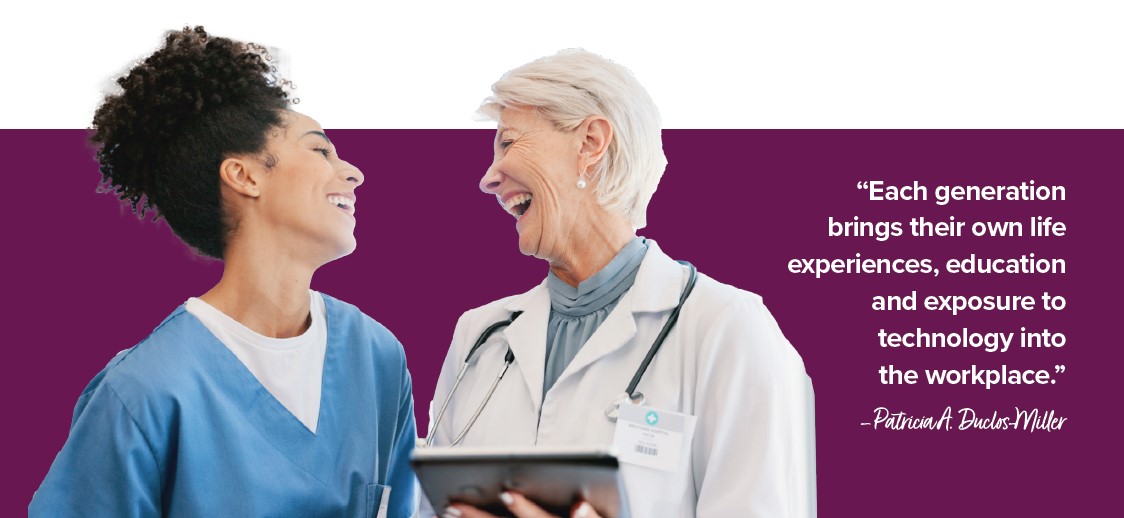
“Each generation brings their own life experiences, education and exposure to technology into the workplace,” says Patricia A. Duclos-Miller, MSN, RN, NE-BC, nursing professional development specialist at Bristol Hospital in Bristol, Connecticut. “Hence, unconscious biases may interfere with working together as we hold onto our own generation’s preferences, work and life experiences.”
According to Ebert, perioperative leaders who can’t effectively address generational differences risk creating a work environment of silos and dysfunction. “We know that a positive team culture promotes better patient outcomes, as well as retention of team members,” she says. “Therefore, understanding the dynamics of a multigenerational workforce has become a core requirement for successful perioperative leadership.”
“Understanding generational differences is not unlike understanding differences between individuals,” says Fontenot.
“Personalized leadership and work settings that are person-centered are critical for all members of the health care organization,” he says. “Leaders who acknowledge this and work with their staff to understand personality and generational differences can be trailblazers and game-changers.”
Common Generational Characteristics
Some common characteristics have been attributed to each generation, including the following:
Traditionalists: Dependable, straightforward and loyal, Traditionalists are also sometimes referred to as the “silent” generation. They were largely shaped by the Great Depression and World War II and tend to be motivated by respect and recognition, placing a high value on organizational structures and respect for authority. Their worldview stresses obedience over individualism, advancing through hierarchy and trust.
Preferred communication style: Formal with a personal touch, such as handwritten notes instead of texts or emails.
Percent of workforce: Traditionalists currently make up just 2% of the total U.S. workforce, which isn’t surprising when you consider that the youngest Traditionalists are 79 years old.
Management tip: Provide employment stability, satisfying work and opportunities to contribute to the greater good.
Baby Boomers: Optimistic, competitive and team-oriented, Baby Boomers are sometimes viewed as workaholics who are committed to climbing the “ladder of success.” They were shaped largely by the Vietnam War, the Civil Rights Movement and Watergate. Baby Boomers tend to be motivated by company loyalty, duty and teamwork. Their worldview stresses achievement after paying one’s dues and sacrificing to achieve success.
Preferred communication style: Whatever is most efficient, whether it’s face-to-face or a phone call, text or email.
Percent of workforce: Baby Boomers currently make up a quarter of the total U.S. workforce. The oldest Baby Boomers are well past retirement age while the youngest are approaching retirement age.
Management tip: Give specific goals and deadlines and offer coaching-style feedback. Also answer questions thoroughly and expect to be pressed for details.
Generation X: Flexible, informal and independent, Gen Xers were largely shaped by the AIDS epidemic, the fall of the Berlin Wall and the dot-com boom. They tend to be motivated by diversity and work-life balance – many possess an entrepreneurial spirit and are willing to invest in themselves. Their worldview stresses diversity and they value access to information and continuous feedback.
Preferred communication style: Whatever is most efficient, whether it’s face-to-face or a phone call, text or email.
Percent of workforce: Generation X currently makes up one-third of the total U.S. workforce. Most Gen Xers are mid-career and at or near their career earnings peak.
Management tip: Provide immediate feedback, flexible work arrangements and work-life balance. Also extend opportunities for personal and professional development and keep them in the loop on important decisions.
Millennials: Competitive, optimistic and achievement-oriented, Millennials were largely shaped by Columbine, 9/11 and the widespread adoption of the Internet. They tend to be motivated by unique work experiences, positive reinforcement, autonomy and the opportunity to assume more responsibility. Their worldview values using technology as a multi-tasking tool, personal growth and development, and a healthy work-life balance.
Preferred communication style: Informal digital communication, whether it’s email, text or instant message.
Percent of workforce: Millennials currently make up 35% of the total U.S. workforce. Most are in the early or middle stages of their careers.
Management tip: Take the time to get to know Millennials personally and be flexible with their schedules and work assignments. Also manage by results, provide immediate feedback and encourage them to take risks.
Generation Z: Global, entrepreneurial and progressive, Gen Zers were largely shaped by the Great Recession and access to digital technology at a very young age. They tend to be motivated by diversity, personalization and opportunities to be creative. Their worldview values independence, individuality and new technologies.
Preferred communication style: Informal digital communication including not just email, text and instant messaging, but also social media, especially Instagram.
Percent of workforce: Gen Zers currently make up just 5% of the total U.S. workforce, which isn’t surprising when you consider that the oldest Gen Zers are just 23 years old.
Management tip: Offer opportunities to work on multiple projects at the same time, along with a high degree of independence. Also, many Gen Zers prefer to work with Millennial managers.

Age-based Employee Stereotypes
Of course, these are just broad generalizations. One of the biggest mistakes leaders can make is stereotyping employees based on their age and generation.
“Common and harmful generational stereotypes include Gen Z lacks work ethic, Millennials are entitled, Gen X are disengaged and Baby Boomers are resistant to change,” says McDonald. “These stereotypes should not be part of the perioperative culture as they create division and hinder teamwork.”
“Stereotypes like these indicate that managers aren’t listening to employees from different generations or willing to understand what each generation can bring to the table,” adds Duclos-Miller. “For example, the stereotype that Gen Z is lazy doesn’t consider that these employees place a value on work-life balance that many Baby Boomers could learn from.”
To dismantle generational stereotypes, Duclos-Miller suggests that perioperative leaders recognize the unique value of each individual.
“Leaders should also recognize the synergies that can be created between employees with different life experiences and perspectives,” she says.
Duclos-Miller outlines a five-step process from author Haydn Shaw’s book “Sticking Points: How to Get 4 Generations Working Together in the 12 Places They Come Apart” for managing a multigenerational workforce and resolving generational differences in the workplace. The five steps are:
- Acknowledge and talk about generational differences.
- Appreciate generational differences. Focus on the why, which is a uniter, instead of the what, which a divider.
- Agree on how to accommodate different approaches to working together productively.
- Leverage and maximize the strengths of each generation.
- Resolve generational differences by determining which solutions will yield the best results and implementing them.
Common Intergenerational Conflicts
Fontenot says most of the intergenerational conflicts and misunderstandings he sees are related to work-life balance. “Every generation has different views on this,” he says. “For example, a Gen X employee might be more willing to work later without additional pay while a Gen Z employee might refuse. Issues like this can lead to conflicts and accusations of an employee not being a team player.”
Ebert sometimes sees intergenerational conflicts arise due to differences in communication styles.
“Each generation possesses a different preference and style of communication,” she says. “In extreme cases, incivility and bullying may result due to unresolved communication differences.”
McDonald stresses that managing a multigenerational perioperative team effectively requires open and effective communication among all team members.
“Leaders must be curious and involved in the team’s daily operations,” she says. “Encourage team members to share their perspectives and preferences and provide a safe forum for doing this.”
Fontenot agrees.
“Being mindful, self-aware and leading with open communication is key. The more we all work together, the better we get at understanding one another, growing together and working as a cohesive team,” he says.
According to Ebert, successfully leading multigenerational teams requires perioperative leaders to acknowledge and appreciate team members’ differences across generations.
“Encourage intergenerational discussion and build a culture of inclusivity and continuous learning for everyone,” she says.
“Most importantly, perioperative leaders must have self-awareness and tailor their leadership styles to meet the needs of the ever-changing and complex workforce,” says Ebert.
Duclos-Miller recommends performing a personal histories exercise in which team members answer three questions about themselves: Where they grew up, how many siblings they have and where they fall in the order, and a unique challenge from their childhood.
Once everyone has spoken, ask them to share something they learned about everyone else that they didn’t already know.
“This exercise will help improve trust by giving team members an opportunity to demonstrate vulnerability in a low-risk way so they can avoid making false assumptions about behaviors and intentions,” says Duclos-Miller.
Another tip from Duclos-Miller: Have team members bring in vacation photos or pictures of their pets. “This opens up conversations about things they have in common,” she says.
Yet another idea is to have team members take the, “What generation am I really?” challenge.
“This can be a real eye opener as everyone doesn’t necessarily line up with their age,” says Duclos-Miller. “It opens up the conversation on how one generation’s traits can align with those of another generation.”
Unite Around a Common Purpose
In the end, uniting team members around a common purpose may be the best way to minimize intergenerational conflicts and build a highly functional multigenerational team.
“Striving together toward a common purpose and set of goals will help unite everyone on the team, regardless of which generation they’re in,” says Duclos-Miller. “Make sure you’re leveraging everyone’s strengths and truly working together as a team.”