
Brenda Ulmer still remembers the exact moment more than 50 years ago when she realized that a career in perioperative nursing might be in her future. Her nursing school program included rotations in the operating room, and while watching a cervical laminectomy at the VA Hospital in Atlanta, her stomach started to growl.
“I recall thinking, ‘If I feel hungry watching an open bleeding wound, this must be where I’m supposed to be!” says Brenda. After graduation, Brenda started work at Emory University Hospital and requested to go directly to the operating room. She was required to work on the floor for six months first but transferred to the OR as soon as she could and has never worked anywhere else.

Brenda’s illustrious career in perioperative nursing spans half a century. During this time, she has worked as a perioperative staff nurse, director of surgical services, perioperative clinical educator and independent consultant. Since retiring from full-time nursing in 2012, Brenda has been an independent perioperative clinical educator and consultant.
Brenda has been actively involved in a number of professional associations throughout her career, including the Association of periOperative Registered Nurses (AORN), for which she served on the Board of Directors and as President, the AORN of Atlanta chapter, and the Georgia Council of periOperative Nurses.
“My involvement with AORN has been my ‘unpaid’ job since I started in the perioperative arena,” says Brenda. “The opportunity to volunteer and promote evidenced-based practice for our professional organization has been as much a part of my career as my salaried positions. The perioperative community both in the United States and around the world is a close-knit and singular entity. We all know nurses from many other countries and frequently share knowledge and experiences related to perioperative patient care.”
Meeting perioperative nurses from across the country and around the world has been one of the most rewarding parts of her career. “These connections make us stronger and benefit patient care and the role of other perioperative nurses,” Brenda says.
Over the years, Brenda has accepted invitations to visit other less economically developed countries than the United States, including some countries where women are oppressed. “I recall thinking in one such country that if even one nurse sees me present educational materials and envisions greater possibilities for herself, the time and difficulty of the travel will have been worth it,” she says.
One of the highlights of Brenda’s perioperative career has been her active involvement in raising awareness of the hazards of surgical smoke and getting surgical smoke evacuation legislation passed. “This is also a happenstance occurrence, but one that has profoundly affected my career path,” she says.
While studying for her master’s degree in 1995, Brenda was instructed to write a paper on some aspect of her work. She chose surgical smoke and soon became aware of just how bad surgical smoke inhalation is for perioperative personnel. “I learned that there was a great deal of information on the hazards of surgical smoke, but nobody had ever gotten together to talk about it,” she says.
Brenda was appointed to chair AORN’s Subcommittee on Smoke in 1996-97. The work of this committee included convening a national conference on Surgical Smoke in Denver. “We included smoke manufacturers and experts from OSHA, NIOSH and other organizations and convened our first smoke roundtable at AORN headquarters in 1996, which was followed by another roundtable conference in 1997,” she says.
According to Brenda, progress on the practice change of evacuating surgical smoke has been slow, but as of December 2025, there are now 18 states with laws regarding the evacuation and filtration of surgical smoke. “I have had the privilege of being involved in this grassroots change,” Brenda says. “It’s gratifying to know that in every one of these states with a surgical smoke law, a nurse went to his or her legislator and started the process of passing legislation.”

Brenda has also written extensively throughout her career. Based on her ambulatory surgery experience, she was approached by a publisher in the early ’80s about writing a book about outpatient surgery. Ambulatory Surgery: A Guide to Perioperative Nursing Care was published in 1983. “There were other positive outcomes from my time with outpatient surgery, but the enduring material of this book is a highlight,” she says.
Brenda is optimistic about the future of perioperative nursing. “In spite of the challenges healthcare and nursing face today, I believe our future is bright,” she says. “Perioperative nurses are realizing how powerful and important the work that we do is. I also subscribe to the philosophy of one of our nursing leaders, Leah Curtin, who said, ‘We in nursing have a tradition with a future, the tender, loving care of human beings will never become obsolete.’”
After 50 years, Brenda says she still loves perioperative nursing as much as she did as a young nurse. “My love of the OR is true for all the reasons you might imagine – a lifelong career filled with learning, advancing surgical care and the worldwide perioperative community,” she says.
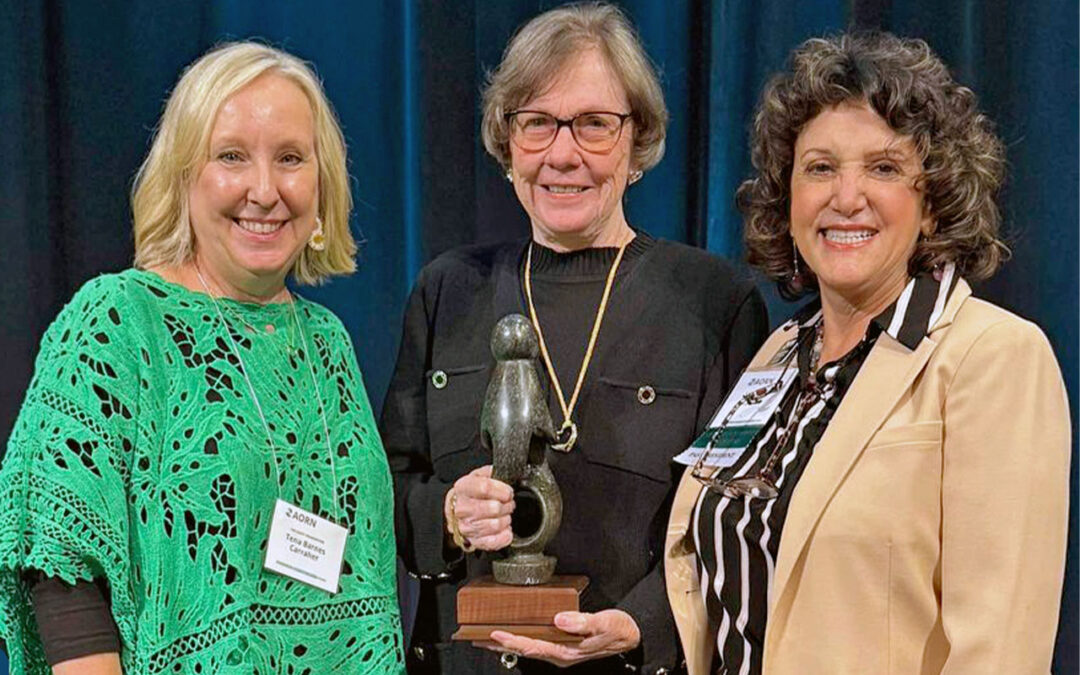
In recognition of her distinguished career, Brenda received the DAISY Award for Extraordinary Nurses Lifetime Achievement Award in 2024. The DAISY Foundation was established in 1999 by members of the Barnes family after their loved one, Patrick died from complications of the auto immune disease ITP. The family wanted to recognize the tremendous care and compassion Patrick’s nurses brought to him and to them during his illness. Brenda is one of the first perioperative nurses to receive the Southeast AORN DAISY Lifetime Achievement Award.
One of Brenda’s longtime hobbies is genealogy. “I’ve traced some of our family lines back centuries all the way to Europe, which is fun,” she says. Using her genealogy experience, Brenda also researched the history of perioperative nursing, which has resulted in two publications detailing the history of AORN: Golden Gavel: Golden Anniversary (2003) and Golden Gavel: Platinum Anniversary (2024).
“My sincere hope is that some of my younger colleagues will take on the task of our next AORN history – and not let another 20 years go by without celebrating how far we’ve come as a profession and an organization,” Brenda says.
Professional Spotlight Nomination
"*" indicates required fields