
From gowns and drapes to catheters, staplers and single-use surgical instruments, disposable medical devices are embedded throughout perioperative care. For nurses working in the operating room, the expanding market is visible in everyday practice: more procedure-specific packs, more single-use technologies and more discussion about whether convenience, infection prevention and efficiency justify the cost and environmental impact.
Market researchers expect that demand to continue growing, fueled by rising procedure volumes, infection prevention priorities, chronic disease and an aging population. At the same time, sustainability concerns and pressure on hospital budgets are shaping how manufacturers develop products and how health systems evaluate them.

For perioperative nurses, those trends make participation in product selection, utilization reviews and value analysis increasingly important.
Although market research firms use somewhat different definitions and methodologies, their forecasts point in the same direction: The disposable medical device market is sizable and continuing to expand.
Fortune Business Insights valued the global single-use/disposable medical devices market at $176.1 billion in 2025 and projects it will increase from $184.8 billion in 2026 to $286.5 billion by 2034, representing a compound annual growth rate of 5.6%. The firm said North America accounted for 31.8% of the global market in 2025.
The firm’s definition encompasses products familiar to OR teams, including gloves, masks, gowns, drapes, syringes, IV sets, catheters, single-use surgical instruments and single-use endoscopes. It describes those products as “deeply embedded in infection prevention protocols” as well as OR workflows and routine patient care.
A February 2026 report from Precedence Research, distributed through Yahoo Finance, offers a similar growth outlook but a somewhat larger long-term projection. It estimated the market at $177.26 billion in 2025 and $187.51 billion in 2026, with the total reaching approximately $310.92 billion by 2035 at a 5.78% compound annual growth rate.
Precedence Research attributed growth in part to chronic disease, surgical procedures, outpatient care, patient safety and home health care. The report described single-use devices as offering benefits that include “preventing patient-to-patient contamination” and reducing the need for cleaning between uses.
For perioperative professionals, one of the most relevant findings is the role surgery plays in market demand.
Fortune Business Insights reported that general surgery was the leading application for single-use devices in 2025 and is expected to represent 30.3% of the market in 2026. The firm linked that position to the multiple layers of disposable protective and functional products used during surgery, as well as growth in minimally invasive and day-case procedures. Hospitals, meanwhile, are expected to account for 64.6% of market demand in 2026.
Precedence Research similarly estimated that general surgery represented 35% of the market in 2025 and hospitals approximately 65%. It also identified catheters and tubing systems as a rapidly growing product category, forecasting a 7.1% compound annual growth rate from 2026 through 2035.
Those statistics illustrate why perioperative nurses can have considerable influence over disposable-device spending. A product decision repeated across hundreds or thousands of surgical procedures can have significant consequences for supply expense, setup time and waste.
MarketsandMarkets valued the global disposable medical device market at $109.49 billion in 2024 and $113.95 billion in 2025. Its forecast calls for the market to reach $144.85 billion by 2030, reflecting a compound annual growth rate of 4.9%.
The firm identifies infection prevention and control of cross-contamination as major market drivers, noting the importance of single-use products in environments including operating rooms, intensive care units and outpatient centers. It said disposable products can reduce the infection-control burden associated with cleaning and sterilizing reusable devices.
MarketsandMarkets also expects drug-delivery devices to post the highest growth among device categories through 2030 as prefilled syringes, autoinjectors and other single-use delivery systems become increasingly common. Technological developments in disposable sensors, wearable devices and monitoring systems are creating additional opportunities.
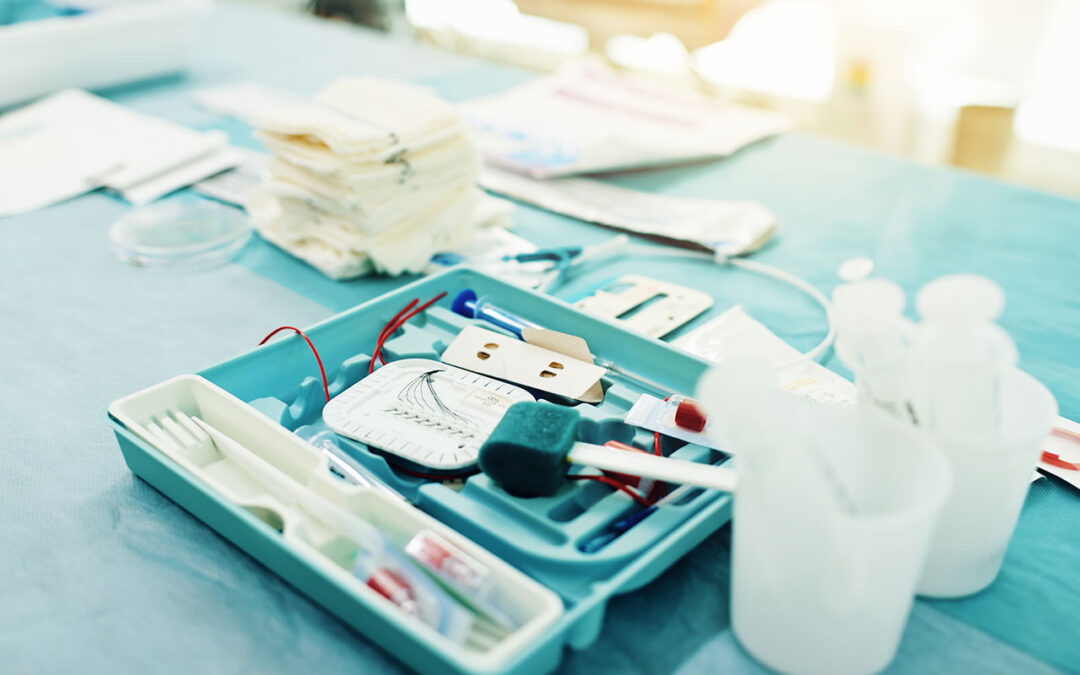
The market, in other words, is expanding beyond basic commodity products. Fortune Business Insights identified a shift toward “premium, procedure-specific kits” and more complex single-use devices as a notable industry trend. Manufacturers are increasingly packaging items such as gowns, drapes, suction lines and small instruments into procedure-specific configurations.
Growth in disposables also means growth in waste.
MarketsandMarkets identifies environmental concerns and regulatory scrutiny of medical waste as significant challenges for manufacturers and health systems. The firm points to increasing interest in biodegradable, recyclable and bio-based materials as manufacturers look for ways to reduce dependence on conventional petroleum-based plastics.
Fortune Business Insights similarly said plastic waste, carbon emissions and disposal requirements may constrain market growth. At the same time, it sees sustainability-focused product design and recycling initiatives as potential areas of innovation.
Precedence Research reported that plastics accounted for approximately 65% of the disposable-device market in 2025 but projected biodegradable materials to grow at an 8.5% compound annual growth rate during its forecast period.
The global market forecasts suggest disposable medical devices will remain a growing part of healthcare and perioperative practice. For OR nurses, the market’s expansion is a reason to be actively involved in determining which products deliver meaningful value – through patient safety, reliable performance, efficient workflow and responsible use of hospital resources.