Susan Klacik, BS, CRCST, CIS, CHL, FCS, AAMIF, HSPA Clinical Educator Emeritus
 The Association for the Advancement of Medical Instrumentation (AAMI) released a new technical information report (TIR) to guide healthcare facilities on the safe external transport of medical devices.
AAMI TIR109:2025 External transport of medical devices processed by health care facilities provides recommendations for transporting processed medical devices in a way that maintains the integrity of sterilized packages. It also provides guidance for the safe and effective transport of contaminated items.
Due to logistical and financial reasons, there has been a growing trend with healthcare facilities transporting items from one facility to another. Whether devices are transported to a facility across the street or at a greater distance, there have been numerous safety concerns related to the practice. The guidance in TIR 109 addresses some of the key challenges healthcare facilities face.

In most cases, medical devices are transported outside of the healthcare facility over public roadways; therefore, the items transported must comply with the specific local, state or federal regulations, including the Department of Transportation’s (DOT’s) Hazardous Materials Regulation, the Occupational Safety and Health Administration’s (OSHA’s) Bloodborne Pathogens Standard (29 CFR 1910.1030), and Environmental Protection Agency (EPA) requirements. TIR109 addresses this regulatory information.
Quality systems are woven into all aspects of sterile processing, and this remains true when performing external transport. TIR109 includes a section describing quality system considerations to ensure work practices and environmental controls maintain the integrity of the product and minimize the potential for contamination of used devices. It is recommended that the healthcare facility have a policy that describes documentation and records, identification and traceability of instruments, inspection and release procedures, safety procedures, training procedures, and supplier controls and monitoring.
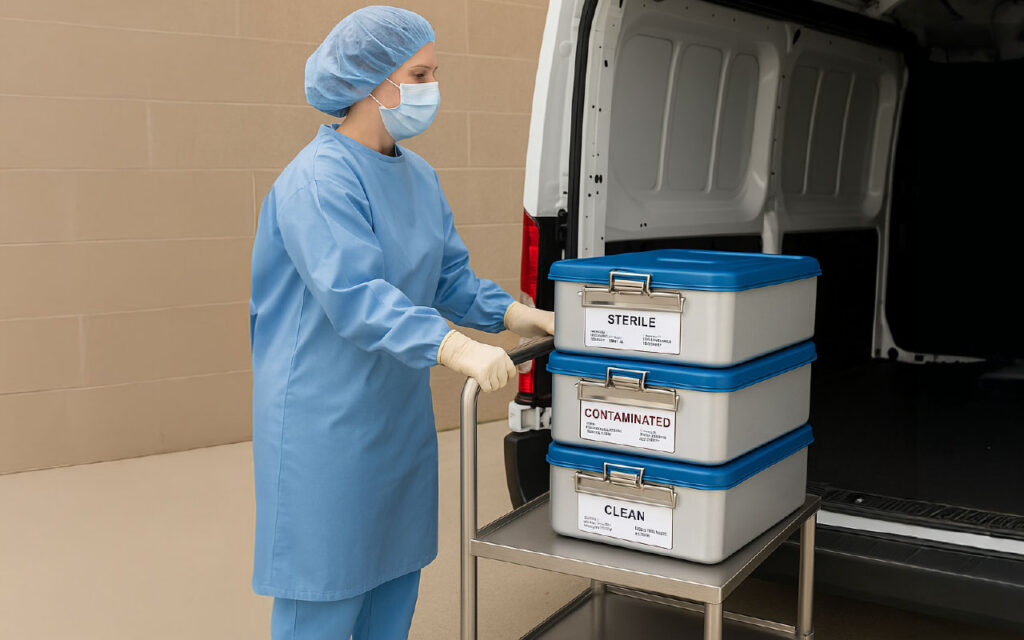
Guidance is also provided for the physical area for both loading and unloading to promote effective and efficient design and processes. Further, the TIR underscores the importance of using the correct transport carrier to prevent device damage and contamination to or from the external environment. Containers should remain closed during transport with a latching mechanism and tamper-evident seals. All transport carriwers should be clearly labeled with the processing status to identify whether the items are clean, sterile or contaminated. They should also clearly identify what is contained, from where the contents originated, and to where they are being transported, as well as the date and time.
Protective packaging can be used to maintain the integrity of a sterile package. TIR109 provides guidance about when and how to utilize protective packaging. Transport carts are another mode used for external transport, and each cart should have a unique identifier that allows for traceability to maintenance records. Recommendations for the types of carts are provided in TIR109. The cart should be able to move smoothly, with little vibration and shock. Regular maintenance on the wheels should be performed to ensure they turn, function and lock properly.
Ergonomics are another important consideration. The handle height should be considered to prevent user strain, and the cart’s maximum gross load should always be followed. The TIR also provides guidance for proper cart cleaning.
Even though transport vehicles are not typically managed by the sterile processing department, TIR109 does include recommendations pertaining to the transport vehicle. The vehicles should be safe and reliable and comply with federal, state and local regulations. It is important to minimize shock and vibration that can damage devices or packaging. The area used to transport items is referred to as the cargo space; this is an enclosed area within the vehicle. TIR109 features requirements for the cargo space that includes protecting the cargo from significant changes in temperature and humidity. The document includes environmental and cleaning considerations for the transport vehicle.
Personnel performing the transport should have training and education. The TIR provides a list of topics that should be included in the training and recommends having policies for any related special licenses and other driving requirements. If an outside transport company is used, the healthcare facility should have a process in place to regularly evaluate their compliance with regulations.
Should a healthcare facility require information about monitoring the external transport condition, TIR109 features an annex with monitoring information. An annex on packaging considerations for transport carriers is also provided and describes how to protect the packaging integrity and contents from damage.
Maintaining the integrity of processed items and following safety precautions for contaminated items is a fundamental practice of sterile processing. TIR109:2025 External transport of medical devices processed by health care facilities provides valuable information to help ensure items are transported safely and in compliance with regulations. This article provides a high-level summary of the guidance in TIR109. The full document can be purchased at https://array.aami.org/doi/10.2345/9781570209048.ch1