If you’ve been tracking this series regarding the concepts found in Stephen Covey’s book, “The 7 Habits of Highly Effective People,” we are now entering the section Covey calls “Habits of Interdependence.” These habits (Habits 4-6) help us work better with other people, whereas Habits 1-3 help us be more effective in planning and managing our own tasks.
We start this section with Habit 4, Think Win-Win. Covey stated he thought Habit 3 (Put First Things First) was the most difficult habit to learn, but over the years I’ve found that more people struggle with internalizing Habit 4.

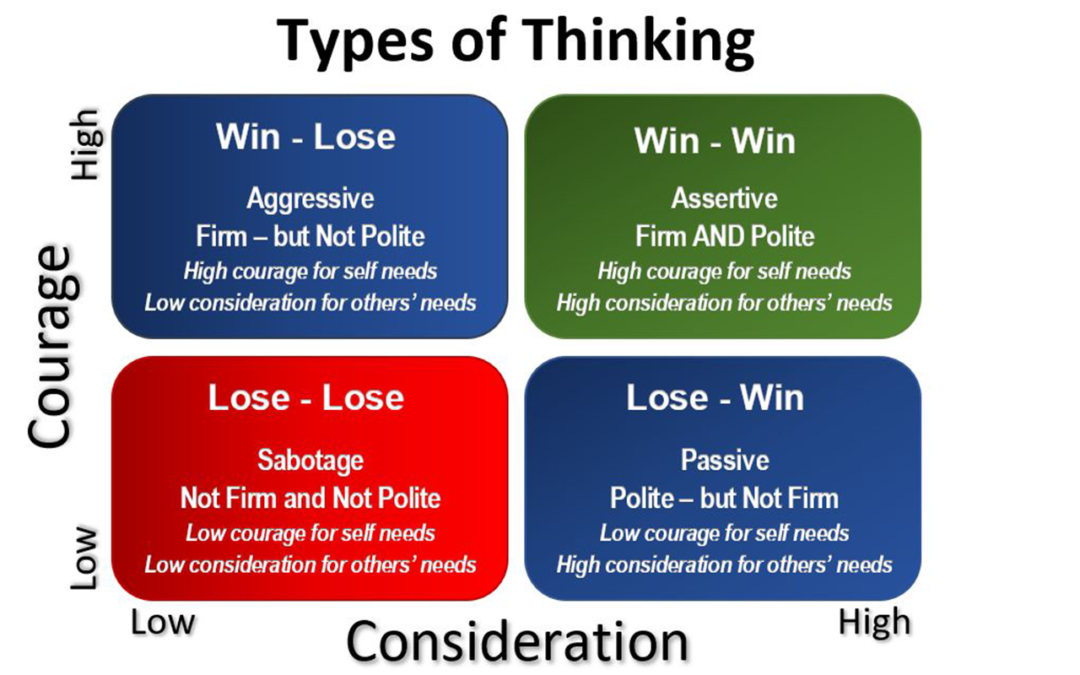
The reason? Thinking win-win is not natural. People tend to be raised with one of two mindsets. One is win-lose, an aggressive way to thinking which means “I’m going to win, and you’re going to lose.” The other is lose-win, which is more passive. People with this view often think, “I’m going to lose so that you can win.”
Other ways of thinking include “Win,” which could be understood as, “I’m going to win. I don’t care if you win or lose, but I’m going to win.” Another is “Lose-Lose.” This is a sabotage mindset that says, “I’m willing to take a loss so that you lose, too.”
Two Components to Consider
The way people think can be easily depicted using a simple graph, with “courage” on the Y-axis and “consideration” on the X-axis. People can have high or low courage, which represents the willingness to stand up for what one wants, and people can have high or low consideration, which represents one’s concern about what others want.
Misunderstanding Win-Win Thinking
One reason win-win thinking is difficult to turn into a habit is that people often go straight to talking about win-win outcomes instead of developing the thinking model needed to achieve those outcomes. Thinking win-win means having a win-win mindset going into a discussion. Yes, it means having strong courage, which means one will be firm to speak up for what one wants, but it also means having high levels of consideration, which is listening to what the other person wants and having a desire to help that person achieve what he or she wants.
Sometimes resolving differences is quite difficult, but that’s what Habits 5 and 6 are for. For right now, it’s vital to work on strengthening the habit of thinking win-win. If it helps, you can look at the pattern found in Habits 2 and 3. Habit 2 (Begin with the End in Mind) is a thinking step, and Habit 3 (Put First Things First) is the doing step that becomes much easier when you’ve practiced Habit 2 first.
In the same way, Habit 4 is a thinking step that involves developing a desire to help others get what they want while also having a desire to stand up for what you want. With that mindset in place, it’s much easier to succeed at Habit 5 (Seek First to Understand, Then be Understood), but Habit 5 is a topic in the next issue.