By Melissa R. Nosik, Ph.D., BCBA-D, ICE-CCP, SHRM-SCP, & Dawn Whiteside, DNP, MSN-Ed, RN, CNOR, NPD-BC, RNFA
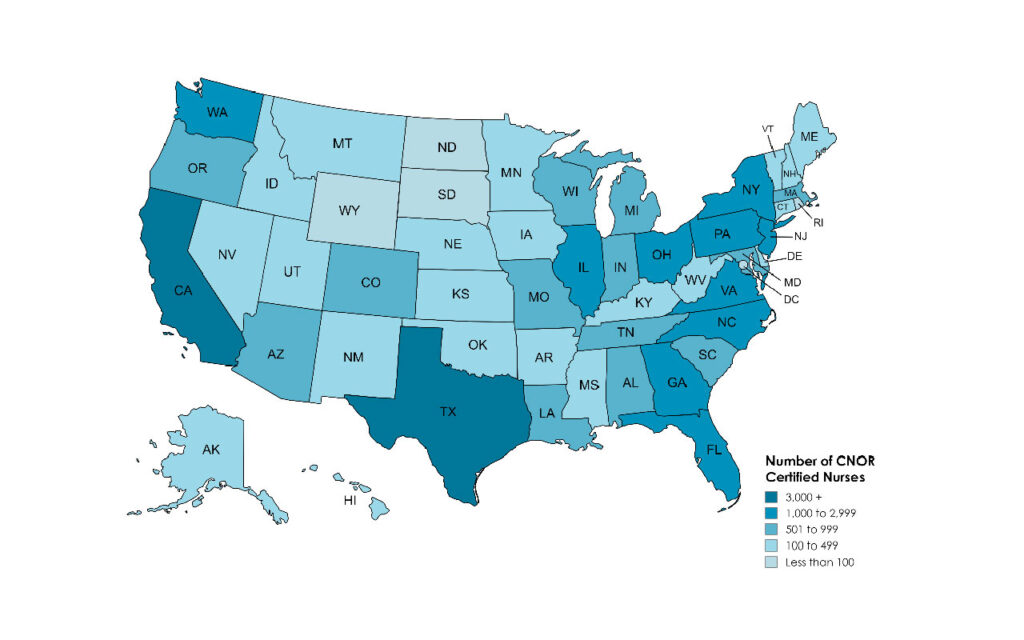
Perioperative nursing, a critical specialty within the nursing profession, involves the care of patients before, during and after surgery. This field has developed a robust professional infrastructure designed to support nurses in delivering high-quality patient care. This article includes data on CNOR certified perioperative nurses in each U.S. state to show volume of credentialed perioperative nurses and then explores the key components of this infrastructure, focusing on the various entities and resources that shape and sustain perioperative nursing.
Current Data on CNOR Certificants in Each U.S. State

Why is Infrastructure Important?
Understanding infrastructure enables the implementation of standardized procedures and protocols. This is especially important in the profession of perioperative nursing. Understanding where we started and what support structures and resources are in place ensures consistent quality in services and a culture of collaboration.
This collaboration creates a foundation for innovation by providing the necessary resources, technologies and environments for advancement of the profession. As nurses become certified, they become a stronger voice and resource for the profession. Many certified perioperative nurses choose to volunteer to coach other nurses on their professional development journey that includes certification in addition to advanced education and role development. The map provided shows the actual number of strong voices that are in every state to represent the perioperative profession and are a key component of the infrastructure of the profession. Exploring how the infrastructure of perioperative nursing is implemented allows the profession to facilitate better communication and coordination among different entities, promoting synergy.
Key Components of the Professional Infrastructure
The professional infrastructure of perioperative nursing encompasses several core entities that provide the primary resources that support the profession. Each entity plays a vital role in ensuring that perioperative nurses are well-prepared, continuously educated, and supported throughout their careers. Although the entities are independent of each other, it is important to consider the strength of the profession when we collaboratively promote and support our professional perioperative nurses.
A few of the key organizations and resources that influence and support perioperative nursing are provided in the table. The Association of periOperative Registered Nurses (AORN) is the primary professional organization for perioperative nurses in the United States. AORN provides educational resources and advocacy for the specialty through legislative initiatives. The Competency & Credentialing Institute (CCI) offers various certifications such as the Certified Perioperative Nurse (CNOR), Certified Surgical Services Manager (CSSM) and Certified Ambulatory Surgery Nurse (CNAMB). These certifications validate the expertise and knowledge of perioperative nurses. Ongoing professional development is essential to the profession and a key standard for all nurses as established by the American Nurses Association. Both CCI and AORN ensure that perioperative nurses stay current with best practices and advancements in the field through various professional development opportunities.
Professional networks, both formal and informal, allow perioperative nurses to share knowledge, discuss challenges, and collaborate on improving patient care practices. Building our networks can start well before nursing school. Outreach to primary education and high school should be a key factor for promoting the profession. As academia continues to focus on NCLEX performance, specialties like perioperative nursing are continually ignored as not being related to the nursing process or too technology based for nursing students. Perioperative nursing needs to be a strong voice about how the profession absolutely practices the nursing process daily and work at collaborating with academic institutions. CCI has partnered with Edgewood College in Madison, Wisconsin for two perioperative electives. AORN collaborates with Chamberlain College to promote perioperative nursing.
The more we collaborate and network outside of our bubble, the more we will be able to truly build a more amazing structure that is built on a firm foundation.
Table: Professional Infrastructure Components and Corresponding Entities/Resources
|
Infrastructure Component |
Entity/Resources |
|
National Professional Associations |
AORN |
|
Credentialing Organizations |
CCI (CNOR, CSSM, CNAMB, CFPN) |
|
State/Regional Associations |
AORN Chapters ANA State Associations |
|
Professional Development Providers |
AORN, CCI |
|
Research Literature |
AORN Journal |
|
Training and Educational Programs |
Academic institutions, Training centers, CCI partner Edgewood College |
|
Ethics Standards |
ANA, AORN Guidelines and Perioperative Explications, CCI Standards |
|
Advocacy Groups |
ANA, AORN Legislative Efforts |
|
Collaborative Networks |
Professional networks, Online forums |
|
Quality Improvement Initiatives |
SCIP, Hospital QI teams |
|
Public Awareness Campaigns |
AORN public education efforts, CCI |
|
Regulatory Agencies |
CMS, OSHA, The Joint Commission |
Conclusion
The professional infrastructure of perioperative nursing is comprehensive, involving a wide range of entities and resources dedicated to the advancement and support of the profession. By participating in national and regional associations, pursuing certification, engaging in continuous professional development, and adhering to ethical standards, perioperative nurses ensure the highest standards of patient care. The collaborative efforts of these entities foster a robust and dynamic field, committed to excellence in surgical patient care.
This infrastructure not only supports perioperative nurses in their current roles but also ensures the continued growth and evolution of the profession, ultimately leading to improved patient outcomes and enhanced professional satisfaction.
– Melissa R. Nosik, Ph.D., BCBA-D, ICE-CCP, SHRM-SCP, serves as the Chief Executive Officer of the Competency & Credentialing Institute. With a wealth of experience spanning 25 years in healthcare practice and organizational oversight, her professional passions encompass professional credentialing, non-profit association management, regulatory affairs, governance practices, and leadership development.
– Dawn Whiteside, DNP, MSN-Ed, RN, CNOR, NPD-BC, RNFA, is the Director of Education and Professional Development of the Competency & Credentialing Institute. Whiteside has over 35 years of experience as a perioperative nurse in many roles including circulator, scrub, first assistant, team leader, charge nurse, manager, and educator.