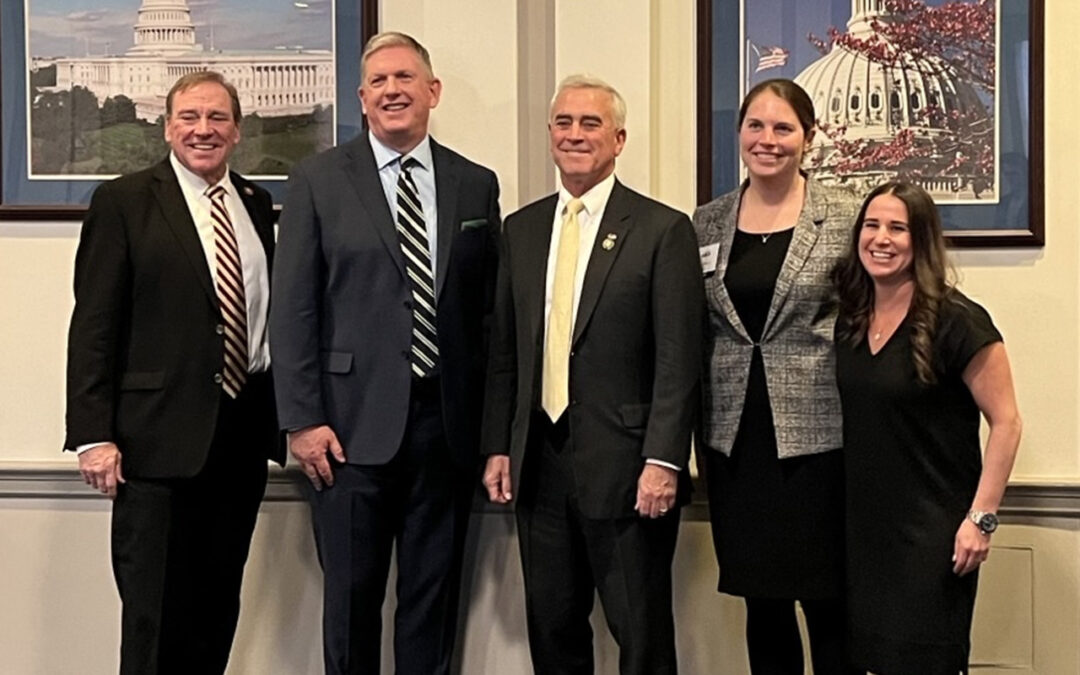
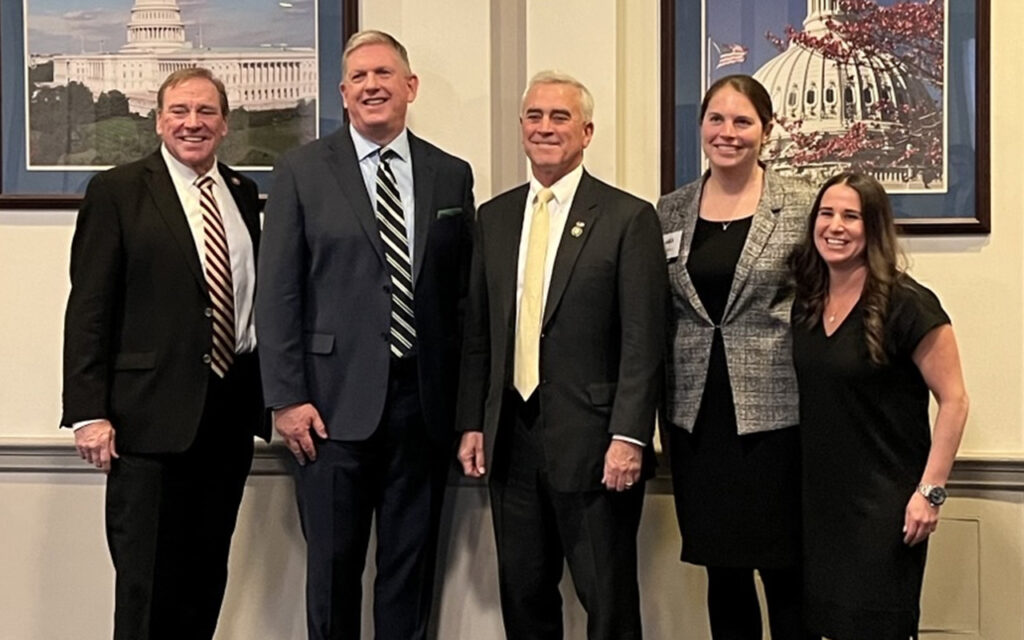
From left to right: Representative Neal Dunn, MD (R-FL); ASCA Chief Executive Officer Bill Prentice; Representative Brad Wenstrup (R-OH); ASCA Director of Government Affairs and Regulatory Counsel Kara Newbury; and ASCA Board President Mandy Hawkins during ASCA’s National Advocacy Day.
By Bill Prentice
ASCA’s advocacy team is having a busy year.
In early February, working with Congressmen Brad Wenstrup, DPM (R-OH) and John Larson (D-CT) and Senators Richard Blumenthal (D-CT) and Bill Cassidy, MD (R-LA), we supported the introduction of the Outpatient Surgery Quality and Access Act of 2023 (H.R. 972/S. 312). This was one of the first pieces of legislation to be introduced in the new Congress. If adopted, it would go a long way toward promoting patient access to the high-quality care ASCs provide while cutting costs for the Medicare program and its beneficiaries.

To spread the word on Capitol Hill about the importance of this proposal, we then helped 70 ASCA members representing 31 states meet with 102 members of Congress during our first in-person National Advocacy Day Washington, D.C., fly-in since the public health emergency was declared. At the federal level, we also:
signed onto a letter encouraging the Centers for Medicare & Medicaid Services (CMS) to facilitate the availability of non-opioid therapies to Medicare Part D patients;
opposed a Federal Trade Commission’s proposed non-compete rule since its inability to apply to health care facilities of all kinds would have unintentionally contributed to the power imbalance it was intended to eliminate;
provided comments prior to a House Committee on Energy & Commerce Health Subcommittee hearing encouraging adequate payments to health care providers and support for policies encouraging the migration of procedures into surgery centers; and
joined other health care organizations in urging Congress to take action that would help stabilize the Medicare Physician Fee Schedule.
This year, we also reached out to Texas legislators to oppose the elimination of facility fees that were being proposed in the state and to United Healthcare, urging them not to enact a prior authorization policy for GI endoscopies. As you read this message, we expect to be preparing our comments on Medicare’s proposed payment rule for surgery centers in 2024.
Amid all that activity, we are placing a high priority on three Medicare policies that need to change to protect and enhance patient access to the many benefits ASCs provide.
First, we are continuing to encourage Medicare to expand its ASC Covered Procedures List (ASC CPL). Ideally, we would like to see this list include all 370 procedures that CMS currently allows in HOPDs but not in ASCs, but as a top priority, we would like to see total shoulders on the ASC list. We continue to present clinical outcomes data to CMS that demonstrates that many procedures that are not currently on the ASC CPL can be performed safely in ASCs and continue to work with CMS to try to develop a meaningful process for adding new procedures to this list.
Second, we continue to urge CMS or Congress to take action that would eliminate the secondary scalar that CMS currently applies to ASC payments, but not to HOPD payments, each year when it updates its payment system. Applying this secondary scalar to ASC payments is exacerbating the growing disparity between ASC and HOPD payments and needlessly increasing the Medicare program’s costs by making it financially untenable for ASCs to perform procedures that are otherwise clinically appropriate for the surgery center setting. When those procedures are performed in HOPDs instead, Medicare, its beneficiaries and taxpayers pay more.
Third, we are asking Congress to implement a patient copay cap in ASCs that would be identical to one it approved in HOPDs some time ago. A Medicare beneficiary typically has a coinsurance responsibility of 20 percent of a procedure’s cost in an ASC, but when they have that same procedure in an HOPD, the copay is capped at the inpatient deductible amount, which is $1,600 for 2023. Medicare then reimburses the hospital for the amount the patient would have paid above that cap as well as its share of the cost of the procedure. Since no comparable copay cap exists in ASCs, patients are incentivized to choose the HOPD setting where their costs are lower but Medicare’s costs are often twice as high or higher. Again, Medicare and taxpayers pay more for procedures that could be performed safely in ASCs.
To make matters worse, this issue primarily impacts those without supplemental coverage – an area where a racial disparity in access has been observed, with only 40 percent of Black beneficiaries being covered by supplemental insurance in contrast to 72 percent of white beneficiaries.
While it has already been a busy year, we have a lot of work left to do. We cannot do this work without our members and the companies that serve our members and support ASCA. If you work in a surgery center, please make sure your facility is an ASCA member. If you have questions about membership, please contact Mykal Cox. If you want to join us for our next D.C. fly-in, please contact Maia Kunkel.
– Bill Prentice, ASCA Chief Executive Officer.