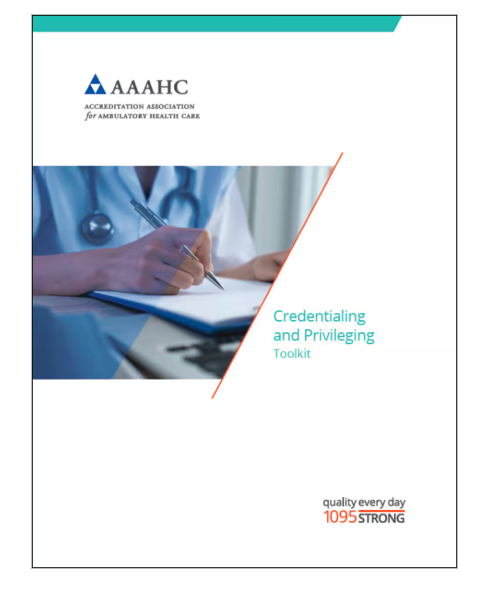
The Accreditation Association for Ambulatory Health Care (AAAHC) has released its updated 2025 Credentialing and Privileging Toolkit, designed to help ambulatory health care organizations streamline and strengthen the process of verifying provider qualifications and ensuring clinical competence. The updated toolkit delivers practical tools and insights to support compliance with AAAHC Standards, accreditation requirements, and regulatory expectations, ultimately helping organizations protect patients, promote peer accountability, and foster a culture of continuous quality improvement.

The revised edition supports primary care and surgical/procedural organizations in developing clear, compliant credentialing and privileging processes. Included are step-by-step flowcharts and updated references to guide organizations through each stage, from initial application to recredentialing.
“The 2025 Credentialing and Privileging Toolkit provides an essential resource for ambulatory health care organizations to help advance clinical excellence and patient safety,” said Noel Adachi, MBA, president and CEO of AAAHC. “This updated version reinforces our 1095 Strong, quality every day philosophy by helping organizations maintain continuous compliance throughout the accreditation term.”
Credentialing and privileging are critical processes that confirm providers, such as physicians, dentists, chiropractors, and allied health professionals, have the education, training, and current competence required to deliver safe patient care. The toolkit delivers an overview of which providers need to be credentialed and privileged, as well as how to manage timelines and ensure scopes of practice are clearly defined.
“Credentialing and privileging are complex processes that touch nearly every part of an ambulatory care organization, from clinical operations to compliance and governance,” said Julie Lynch, director of the Institute for Quality Improvement for AAAHC. “The 2025 edition provides updated resources while outlining the steps to develop and sustain a robust process, that align with AAAHC Standards and regulatory requirements. This toolkit is more than a resource; it’s a roadmap to protect patients and support professional accountability.”
The toolkit also emphasizes the importance of maintaining up-to-date credentials and privileges, especially for organizations not using credentialing software. It reinforces that compliance is not only required by regulatory bodies but is essential to a culture of professional trust and high-quality care.
The 2025 Credentialing and Privileging Toolkit reflects AAAHC’s ongoing commitment to supporting continuous quality improvement across the 1,095 days of the accreditation term. It is part of a broader suite of educational and operational resources available to AAAHC clients and other ambulatory health care organizations.
The full AAAHC toolkit collection, including the 2025 Credentialing and Privileging Toolkit, can be found at https://store.aaahc.org/toolkits. Additional information on AAAHC programs, client education, and accreditation services is available at aaahc.org.