
 Brainlab, a digital medical technology company, has announced United States Food and Drug Administration (FDA) 510(k) clearance and U.S. launch for Spine Mixed Reality Navigation.
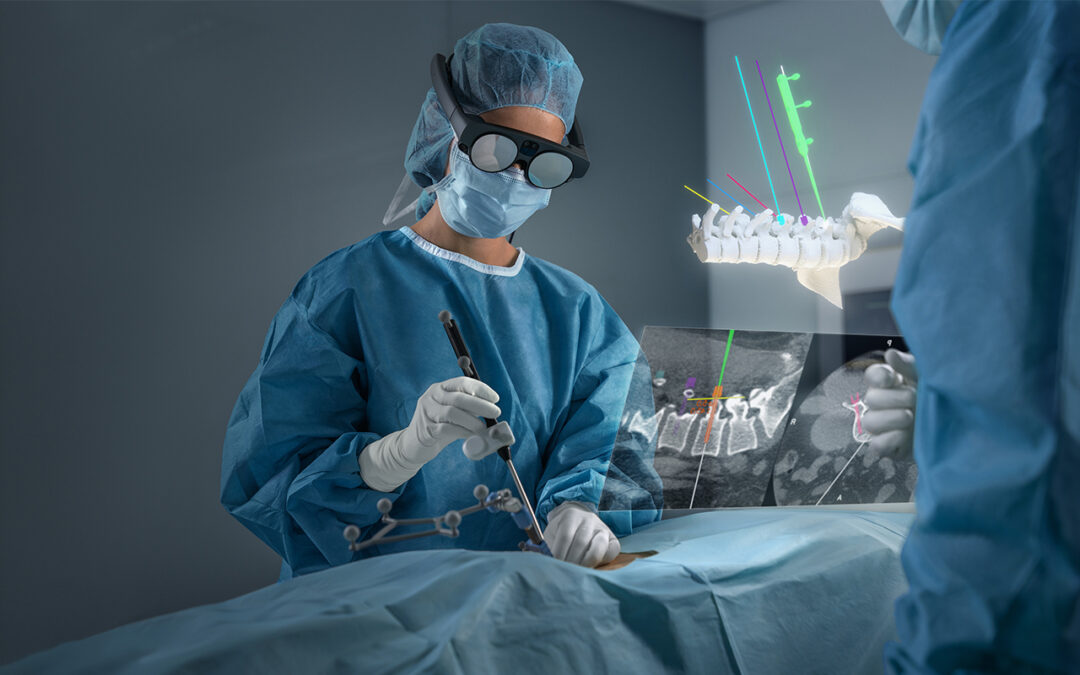
“This advanced surgical navigation solution equips users with mixed reality support, delivering an ergonomic view of the navigation screen and allowing surgeons to place pedicle screws with the vital information directly in their field of view,” a news release states.

Spine Mixed Reality Navigation combines the reliability and precision of the company’s signature optical navigation system with advanced mixed reality, it adds.
“This extended visualization is projected directly in the sterile field delivering a layer of confidence one step beyond traditional technology. With real-time visualization of entry and target points, Brainlab Spine Mixed Reality Navigation enables desired placement of pedicle screws according to the surgeon’s pre- or intraoperative plans, including in MIS cases where target identification is challenging,” the release continues.
Jason Pittman, MD, Ph.D., FAAOS, spine surgeon at Beth Israel Deaconess Medical Center in Boston, and a long-time Brainlab navigation user, has provided critical clinical feedback throughout the development of Spine Mixed Reality Navigation.
“Since my first introduction to Spine Mixed Reality Navigation at the Brainlab Usability Summit cadaver lab, I’ve been eager to work closely with them on their solution,” said Pittman. “Further hands-on opportunities at the company’s headquarters in Munich and Chicago have led me to believe that this solution is the future of the operating room. There is clear clinical value in Spine Mixed Reality Navigation with the enhanced visualization, accuracy and trueness.”
Pittman also explained how the ergonomics of Spine Mixed Reality Navigation deliver the added benefit of providing vital navigation information within the same field of view as the patient anatomy. During the Usability Summit, the 3D “floating view” and virtual navigation views eliminated the need to continually look from the operative site to the navigation screen and back, allowing participants to keep their constant focus on the anatomy, optimizing cognitive load and allowing them to efficiently place 100 screws over two days of testing. Pittman said that the headset itself is comfortable to wear, even during the seven hours spent in the lab. He is excited to adopt this technology in his OR where he will be able to collaborate in real time with colleagues and residents both in and outside the sterile field, fostering seamless teamwork, learning and training.
“We’re ushering in the future of spine surgery, putting groundbreaking tools in the hands of U.S. surgeons,” Brainlab President Sean Clark said. “European surgeons are already experiencing the power to see, critically observe and optimize clinical procedures with Spine Mixed Reality Navigation. This solution delivers hyper realistic 3D visuals and extended visualization, while the workflow, instruments and navigation provide familiar and expected precision. Together with our customers, we’re driving accuracy in the OR.”
Spine Mixed Reality Navigation is now available in the U.S.