By Richard Parker, MBA, CHFM, CLSS-HC, FASHE, FACHE
Accreditation surveys can be stressful when you don’t know what to expect. You know a life safety surveyor will tour your surgical environment, but what are they looking for exactly? The life safety lens focuses on fire safety, electrical safety and other patient protective features specific to surgery.

Understanding that perspective, OR leaders can be better prepared for this non-clinical portion of a survey and help their staff understand the kinds of questions that might arise.
Fire Safety
Hospitals and ASCs are required to perform fire drills, once per shift per quarter. Routine fire drills meet requirements for general patient areas; however, surgical departments have unique risks when it comes to a fire. Staff may be asked about the fire response when the fire is in or on a patient. The surveyor is looking for is a description of the roles and responsibilities for each portion of the fire triangle.
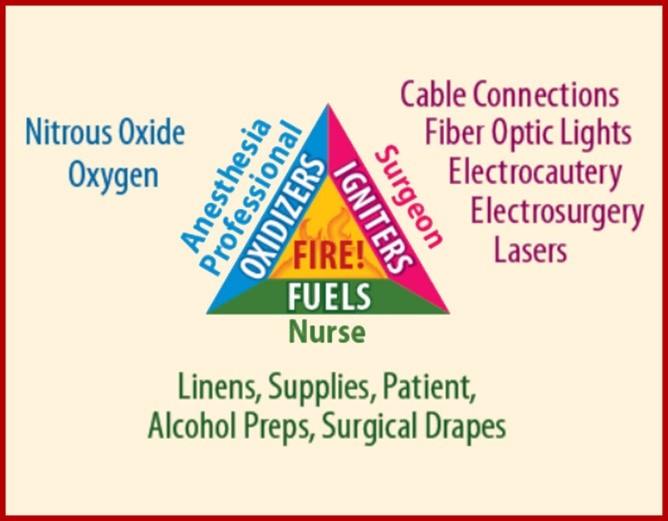
The image here from the Anesthesia Patient Safety Foundation is a good tool illustrating the individual in control of eachelement of the fire. Staff should be able to articulate this portion of the fire response plan and describe the training and drills performed within the past year.
The surveyor will also look for fire extinguisher types and locations. In the operating room a “clean agent” fire extinguisher is typical due to its potential use in or on the patient. Fire extinguishers outside of the operating room are typically ABC-rated. The surveyor will observe whether fire extinguishers are accessible without obstruction.
Electrical Safety
Electrical safety precautions protect staff and patients. There are several different components for an environment safe from electrical shock, including medical equipment, power strips and electrical circuit panels.
The life safety surveyor will examine the medical equipment in the operating room. They will observe the inspection stickers to validate that equipment is being routinely tested and maintained. They will note the condition of the equipment for cleanliness and condition.
The use of power strips in operating rooms must meet certain criteria. The life safety surveyor will assess these to verify that they are permanently mounted as required by NFPA 99-2012 Health Care Facilities Code.
Electrical safety is also assessed through observation of the access to and the type of electrical panel. The surveyor will note whether the electrical panels are accessible with 3-feet of clearance. Some operating rooms are equipped with a line isolation monitor (LIM) that protects against electrical shock. The LIM must undergo inspection and testing which will be surveyed during the document review session with the facility manager.
Other patient protective features
Proper ventilation, temperature and humidity control are critical components to patient safety. During the tour of the space, the life safety surveyor will observe pressurization of the operating rooms, clean core space, sterile storage and decontamination areas.
Proper pressurization will make the cleanest space, such as a sterile operating room, positive to a less clean space. This protects the patient from airborne contaminants when the patient is most vulnerable. The surveyor will test pressurization at the entry doors where there is a gap for airflow such as at the bottom of the door.
Temperature and humidity are normally observed via logs maintained by the surgical or facility staff. During a review, out of range notations will prompt a question: What did you do about this? Corrections to out of range temperature and humidity must be documented.
The surveyor will observe exit signs and physical exits from the department and verify ease of access. This observation will include whether corridors are cluttered with equipment, beds or stretchers. OR leaders should work with the facility manager to understand whether the surgery area is a suite as defined by the Life Safety Code. That determines whether there is any flexibility with equipment in the corridor.
While observing corridors, the surveyor will observe medical gas shut-off valves for access. Accessibility means that shut-off valves cannot have any equipment, stretchers or beds parked in front of them. This is a common challenge for surgical departments due to the location of the valves and that each operating room has its own set of valves.
Lastly, the life safety surveyor will observe general maintenance and cleanliness of the surgical areas. This survey element commonly crosses over with the tasks of a clinical surveyor in that it also relates to infection prevention. The surveyors will observe the floor for seams that are pulling apart, walls for damage, door frames for damage to paint, and for rust issues. This may include observing equipment, X-ray shields, operating tables and pads. The space and equipment must be maintained in a way that cleaning is effective.
Managing compliance readiness for the Life Safety Surveyor
- Create a checklist and self-survey for these elements of the surgical physical environment.
- Raise awareness among the operating room staff. Consider rotating the checklist to different leaders within the department.
- Partner with your facility manager for routine rounds and education on the safety features of the space. The ultimate responsibility for patient safety in surgery belongs with the OR leader. Understanding these elements contributes to the patient’s safety and readies you and your staff for survey.
 Richard L. Parker is associate director, physical environment and life safety at Accreditation Commission for Health Care Inc. where he provides guidance to customers and surveyors in the ASC and hospital programs. Prior to joining ACHC full-time, he was a surveyor in the HFAP program while serving as executive director of facilities for a 615-bed hospital system in Arizona.