By Darcie Opalko, Gini Beatty, and Lisa Rosenfield

Darcie Opalko
As bundled care payments have become increasingly more common, the facility reimbursement process has dramatically changed. Payors, as the buyers of services, can negotiate prices for services, which results in an increased focus on value-based purchases. The payor’s ability to negotiate cost savings necessitates an interdependence wherein facilities must maximize their resources for optimal outcomes.

An additional component of partnerships extends beyond the hospital facility to embrace external partners. These types of partnerships can be cultivated within the community, with industry experts, and with other businesses. Both internal and external types of partnerships have immeasurable benefits for patients, nurses, facilities, communities, and to the profession as a whole.
Advantages of partnerships between the hospital and the OR
Henry Ford once said, “If everyone is moving forward together, then success takes care of itself.” One might ask why this is important within a healthcare setting? However, this is exactly the place where teamwork and collaboration must exist to ensure success.
Creating partnerships inside the hospital not only aligns everyone to a shared goal, but also minimizes risk for all parties involved. The advantages of these partnerships allow for patient optimization, which in turn increases patient safety and minimizes financial loss due to untoward results. Collaboration among the entire healthcare team allows for in-depth conversations and ultimately a just culture where every person, from every discipline, becomes a stakeholder for patient care.
The challenge comes when a patient’s diagnosis and, unfortunately, their insurance coverage drives decisions. There are times when insurance will deem a certain procedure or medication unnecessary or investigational, which often forces the patient and medical team to be overburdened with appealing such decisions. This is a cumbersome process, but when you have a collaborative team fighting for the shared goal of the patient, it becomes valuable. Patient optimization has never been as important as it is right now in the Perioperative areas. Working as a team to ensure patients are given the tools and education, they need prior to their procedure allows for their insurance coverage and overall outcome to be maximized.
From Graduation to Certification: A Partnership for Success
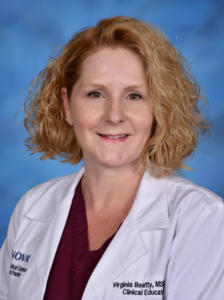
Gini Beatty
In the current healthcare climate, recruitment and retention are an ongoing concern for perioperative leaders and educators. New graduate nurses are faced with increased patient acuity and growing case volumes. Guiding them through reality shock and their transition to practice can be a daunting task. These new graduate nurses may have faced abbreviated acute care clinical experiences in favor of more simulation and web-based learning.
As an organization, Inova Health System has chosen to utilize the Certified Foundational Perioperative Nurse (CFPN) credential as a benchmark for successful completion of our Perioperative Nurse Fellowship program. By establishing a collaborative relationship with CCI over the past several years, Inova has developed a program to prepare our fellows to achieve their CFPN credential immediately upon completion of their fellowship.
The fellows complete a weekly review session with an organizational educator to review each subject area covered on the CFPN Knowledge-Based Test (KBT). These sessions are completed by the end of their orientation period. Once eligible, each candidate receives a voucher for the CCI on-demand prep course and for the knowledge-based test as well as the other three components of the CFPN credential.
This is a program which is made possible through an agreement reached between Inova and CCI. CCI has aided the candidates, as well as the organizational representatives, to ensure a smooth navigation of the application and certification process. This program has been instrumental in imparting the value of credentialing on our foundational nurses and starting them on their path of lifelong learning, continued certification, and professional development.
Partnerships are necessary not only for providing optimal care to patients, but also for maximizing the value of the reimbursement. Strong partnerships – both within the hospital and beyond – cultivate many lasting benefits and rewards.
——————————————————————————————————————————-
Darcie Opalko, MBA, MS, RN, CSSM, CNOR, NEA-BC, is the Director of PeriOperative Services Penn Highlands Mon Valley Hospital. She has 26 years of experience within Surgical Services as an RN and Surgical Technician, with 15 years in a Leadership role helping to foster positive relationships throughout the hospital. Darcie holds a BSN and an MS/MBA.
Gini Beatty, MSN, RN, NPD-BC, CNOR, is a Clinical Nurse Educator in the Cardiovascular Operating Room at Inova Fairfax Medical Campus. She utilizes system strategies and tools to assess the competency of new nursing staff members while focusing on quality of care and patient safety goals. She integrates theoretical knowledge, evidence-based principles, and clinical nursing expertise into educational experience for both new employees and experienced staff. Gini holds an ADN, a BSN, and an MSN.
Lisa Rosenfield, MA, works in the area of Special Projects and Partnerships at the Competency and Credentialing Institute. Her scope of work includes designing, executing and managing organizational-wide initiatives and signature programs, operationalizing the strategic work of the organization, and cultivating/maintaining external partnerships. Lisa holds a BS and an MA.